Discussion published on Nov 3, 2014, but just as relevant today as back then.
What is Washington’s strategy against the Islamic State? Is the Islamic State a creation of the United States? Is the war on terror really a war on Islam? Will the US make amends with Iran in order to defeat the Islamic State? What is Wahington’s endgame?
CrossTalking with Ken O’Keefe, Majid Rafizadeh, and Peter van Buren.
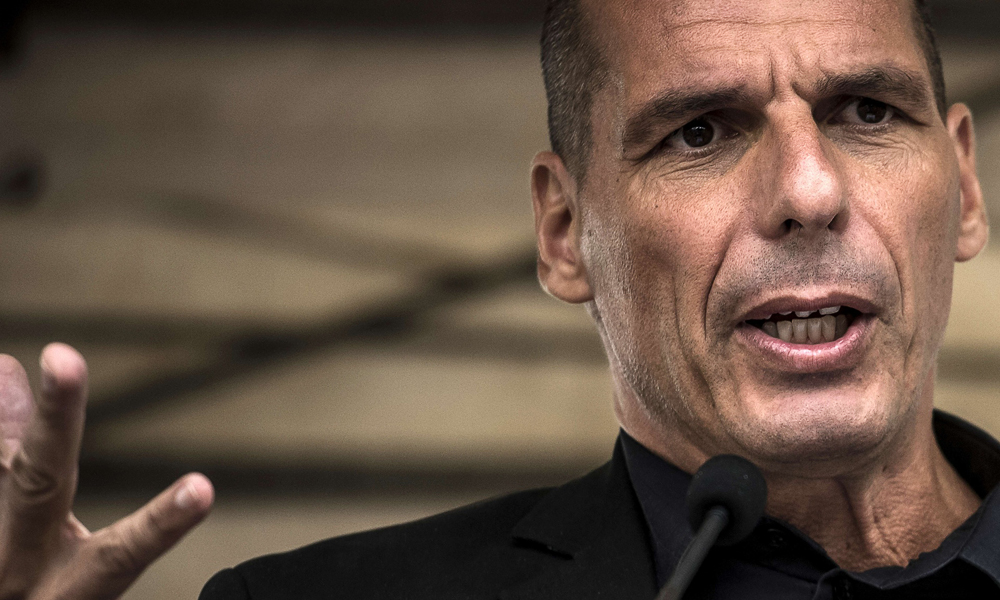
Former Greek Finance Minister Yanis Varoufakis (image: Jean-Philippe Ksiazek/AFP/Getty)
By Pepe Escobar
Seven months after resigning as the finance minister of Greece, self-described “erratic Marxist” Yanis Varoufakis is resurfacing (out of the Aegean Sea?) with a bang.
This past Tuesday, at the Volksbühne Theater in Berlin, Varoufakis launched a new project: the DiEM25 (Democracy in Europe Movement 2025), whose aim is to ultimately transfer power from Europa’s unaccountable, fiercely authoritarian elite and distribute it – fairly – among European citizens.
Greek myth? Why not? And exactly when Europa badly needs a new foundation myth. Varoufakis bets that the movement will eventually reach a “basic consensus” on what to do to really introduce democratic practices into how the European behemoth is run. And then, onwards to parliamentary democracy, via elections.
The diagnostic by Varoufakis would resonate among every sound minded EU citizen. It features unaccountable European elites; “big finance” and “big industry” forming the “unholy cartel” that is the “main driver of EU policy”; the European Central Bank (ECB) propping up the “cartel” by printing money like there’s no tomorrow through quantitative easing (QE); Italy as the new Greece, suffocated by its debt repayments; the fallacy of the theoretically apolitical ECB controlling interest rates across vastly disparate countries; and the Mafia behavior of the Eurogroup (comprising the 19 finance ministers of eurozone members).
Not surprisingly, the fallacy of this “model” of running the eurozone has produced devastating unemployment and facilitated the rise and rise and rise of the extreme right.
The concept of DiEM25 is inspired by what people across Europe should have done in the 1930s, before the ascension of Nazism and fascism; a pan-European, trans-political democratic movement. Varoufakis identifies all the toxic trends of the 1930s in the current, abysmal turmoil engulfing Europa.
He wants DiEM25 to be more than “just a think-tank and… an internet community”.
At the same time he’d like the movement to be essentially leaderless. And there’s the rub; Europa may not need heroes, but as it stands it definitely needs true leaders.
The pseudo-documentary film World War Three: Inside the War Room was described in advance by the BBC as a ‘war game’ detailing the minute by minute deliberations of the country’s highest former defense and security officials facing an evolving crisis involving Russia. What gave unusual realism and relevance to their participation is that they were speaking their own thoughts, producing their own argumentation, not reading out lines handed to them by television script writers.
The mock crisis to which they were reacting occurs in Latvia as the Kremlin’s intervention on behalf of Russian speakers in the south of this Baltic country develops along lines of events in the Donbas as from the summer of 2014. When the provincial capital of Daugavpils and more than twenty towns in the surrounding region bordering Russia are taken by pro-Russian separatists, the United States calls upon its NATO allies to deliver an ultimatum to the Russians to pull back their troops within 72 hours or be pushed out by force. This coalition of the willing only attracts the British. After the deadline passes, the Russians ‘accidentally’ launch a tactical nuclear strike against British and American vessels in the Baltic Sea, destroying two ships with the loss of 1200 Marines and crew on the British side. Washington then calls for like-for-like nuclear attack on a military installation in Russia, which, as we understand, leads to full nuclear war.
The show was aired on 3 February by BBC Two, meaning it was directed at a domestic audience, not the wider world. However, in the days since its broadcast it has attracted a great deal of attention outside the United Kingdom, more in fact than within Britain. The Russians, in particular, adopted a posture of indignation, calling the film a provocation. In his widely watched weekend wrap-up of world news, Russia’s senior television journalist Dimitri Kiselev devoted close to ten minutes denouncing the BBC production. He cited one participant (former UK Ambassador to Russia Sir Tony Brenton) expressing pleasure at the idea of ‘killing tens of thousands of Russians.’ This segment was later repeated on Vesti hourly news programs during the past week. Kiselev asked rhetorically how the British would react if Moscow produced a mirror image show from its War Room.
The documentary I posted last week (Kiev: The Masks of Revolution), unfortunately turned out to be the wrong one. Not that it’s a bad film, but here’s the right one below with English subtitles. Sorry for the confusion 🙂
In Kiev’s Independence Square, a battle rages on between a makeshift army of Molotov cocktail-throwing protesters who are demanding the resignation of President Viktor Yanukovich and his government, and a phalanx of black-clad Berkut state riot police. The protesters insist that their country has been betrayed by a corrupt government that has chosen to align itself with Russia and halt Ukraine’s aspiration to build closer ties with the European Union. However, as the death toll continues to rise and smoke from the flames of burning vehicles hangs over the very heart of the capital, many questions are left unanswered. Just who are these protesters, and why is “Euromaidan” so much more ugly and violent than the Orange Revolution of nine years ago? What role is the ultra-nationalist “Right Sector” playing in this uprising, and who is paying for its expenses?
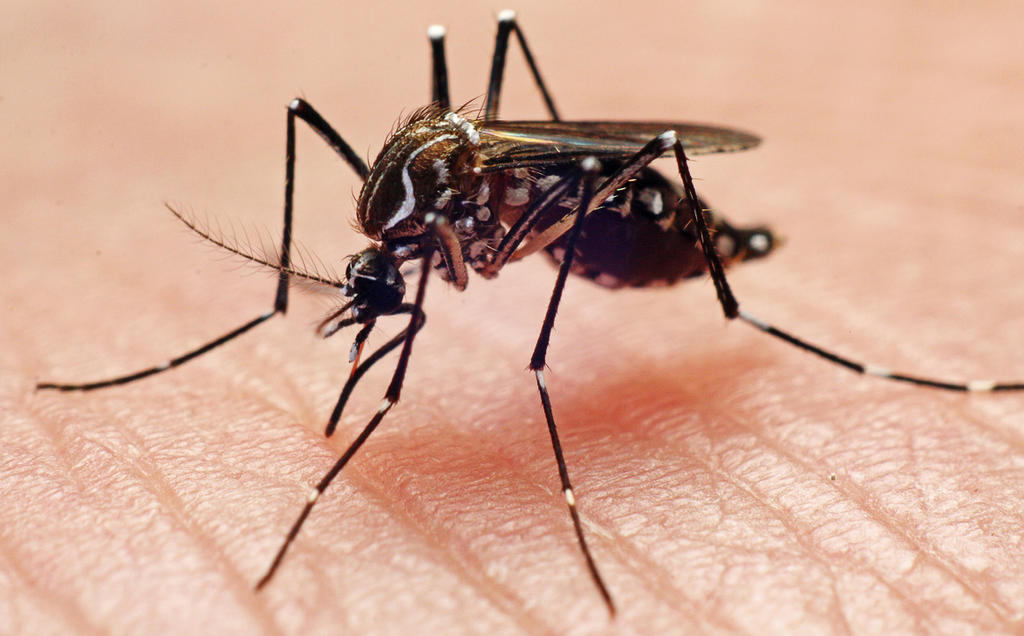
A bite from the wrong Aedes aegypti mosquito can give a person dengue, yellow fever, chikungunya, or Zika. (image: Wikimedia Commons)
Until a few months ago, you might have never run across the name “Zika.” The virus is named for the Zika forest in Uganda where scientists first identified it in 1947.
Since then, scientists have figured out the basics for how the virus works. Zika spreads through mosquito bites, with symptoms like fever and joint pain that usually appear a few days later. Because of how it spreads and the nature of these symptoms, Zika is often compared to dengue fever, also called “breakbone fever.” But Zika is generally milder—only about one fifth of patients develop any symptoms, and most who do are back to normal within a week. So far, Zika has not caused any deaths. There’s no specific treatment or vaccine for Zika; those infected usually just need to take aspirin, drink water, and get lots of rest.
Researchers, however, have recently found a new, disturbing side effect. In October, epidemiologists studying the current outbreak in Brazil noticed a higher incidence of microcephaly, a rare neurological condition in which babies are born with smaller than normal heads and underdeveloped brains. Microcephaly is usually rare, but in some areas where Zika was particularly common, the condition was popping up many more times than it had in previous years–Brazil public health officials reported that in 2015, 3,000 babies were born with the condition, compared to 20 the year before. They noticed more babies with microcephaly were born to mothers infected with Zika, even if they didn’t show any symptoms.
Researchers are still not certain how Zika is triggering the increased incidence of microcephaly. But the connection is causing panic—so much so that the Brazilian government recently told women in the country’s northeast, where the epidemic has hit hardest, not to get pregnant for fear of these birth defects.
The cat-tossing chicken-leg-masturbating young ladies in Pussy Riot have re-emerged from their whirlwind tour of becoming famous by mocking their homeland. They have resurfaced with their usual schtick, but this time they have gotten themselves a fancy Hollywood-type hipster music producer to fix their shitty tracks, and they have joined the ranks of Iggy Azalea wannabes everywhere and become white rappers.
This is a new Pussy Riot. It’s a slick, glammed-up, sexed-up Hollywoodized version of what was, for better or worse, originally a fringe protest group. That, you know, just liked to draw penises on stuff. And maybe tipped over cop cars with a couple of officers inside. Girls will be girls.
The Russian Ministry of Culture tried to give Voina (their name previous to becoming Pussy Riot) a prize for artistic innovation. But they said no. And now, they’ve made it all the way to an American music video. Let’s give these girls a Grammy!
Chaika accuses embattled Russian Prosecutor General Yuri Chaika of corruption and various crimes, including murder. Their stated goal is to target corruption in Russia.
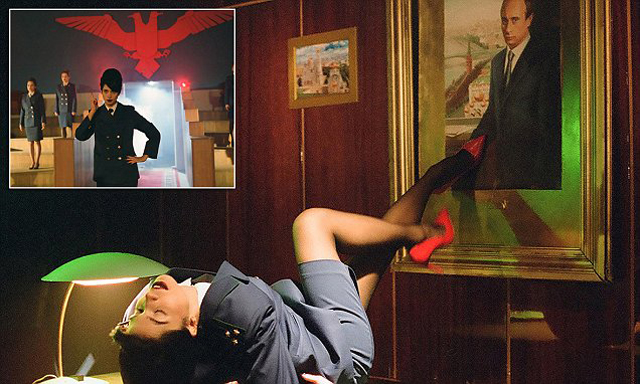
The video begins with a Pussy Riot band member, sporting a Soviet uniform, eating an entire rotisserie chicken with her bare hands. (I’m pretty sure we’ve all been guilty of that at some point, so it’s unclear how this is an indictment of Russian corruption.)
Enter Nadezdha Tolokonnikova, dressed up like a non-coke-addicted Amy Winehouse, writhing orgasmically under a picture of Putin and fellating a plastic loaf of bread while rapping about Yuri Chaika. Other feminist tropes emerge, including bare legs in stilettos and fishnet stockings. The members who are not portraying Amy Winehouse are either wearing a plague mask (??) or clad in drab Soviet-era uniforms, clunky shoes and bad make-up.
Real edgy, girls. Please, tell us more about how you’re not afraid to orally pleasure baked goods in Putin’s Russia.
In Kiev’s Independence Square, a battle rages on between a makeshift army of Molotov cocktail-throwing protesters who are demanding the resignation of President Viktor Yanukovich and his government, and a phalanx of black-clad Berkut state riot police. The protesters insist that their country has been betrayed by a corrupt government that has chosen to align itself with Russia and halt Ukraine’s aspiration to build closer ties with the European Union. However, as the death toll continues to rise and smoke from the flames of burning vehicles hangs over the very heart of the capital, many questions are left unanswered. Just who are these protesters, and why is “Euromaidan” so much more ugly and violent than the Orange Revolution of nine years ago? What role is the ultra-nationalist “Right Sector” playing in this uprising, and who is paying for its expenses?
Today marks seven years since President Obama signed an executive order calling for the closure of Guantánamo Bay within one year. But Guantánamo remains open, and now Obama only has one year left to fulfill his pledge. We are joined by the world famous musician Roger Waters, who has helped launch the “Countdown to Close Guantánamo” campaign, which asks people to take photos of themselves with signs calling for Guantánamo’s closure before Obama leaves office in 2017. Waters is a founding member, bassist, singer, songwriter for the iconic rock band Pink Floyd, perhaps best known for their record The Wall. For three years between 2010 and 2013, Waters toured the world with a dazzling concert of the same name. We are also joined by Andy Worthington, a British activist and investigative journalist who co-founded the “Countdown to Close Guantánamo” campaign.
The skies above Syria are crowded with military planes from various nations. However, the non-stop bombardment of Islamic State (IS, formerly ISIS/ISIL) seems to be producing nothing in return. The group still maintains the ability to strike anytime, anywhere – even in the US. And while Western nations along with Russia are trying to destroy IS, some of America’s alleged “allies” in the region seem to be playing their own game. Can a war be won in such conditions? Can progress be made if only some are committed to end the fighting? We pose these questions, and many more, to an ex-CIA agent and counter-terrorism expert. Philip Giraldi is on Sophie&Co today.
Shaker Aamer, who spent over a decade in Guantanamo bay, has talked to RT about how the prison works and why the detainees have not been prosecuted after 14 years of confinement. Here are his best quotes from the interview:
On the prosecution of detainees
Saudi born UK citizen Aamer, who was held in Gitmo from 2002 until October of last year, explained that the government cannot prosecute the detainees because “it will show the failure of intelligence services” as they cannot prove that the detainees “did anything wrong.”
On how Gitmo operates
“Guantanamo is being run by one concept – how to destroy a human being,” he told RT. “Guantanamo is not a detention facility, it’s not like a normal jail,” he said, adding that it is “run by psychologists, by psychiatrists,” who know how to “manipulate.”
On torture
Apart from the physical torture, he said there is also “mental torture.”
“They know nothing will affect us more than insulting our religion. Nothing will make us break like grabbing our Holy Koran and throwing it in front of us or just opening it …searching it.”
“You are talking about people who are very loyal to their religion, truthful believers.”
On ‘enhanced interrogation’
US officials have decided to call the new methods of interrogation used in Guantanamo “enhanced techniques,” he said, adding that these include keeping an inmate standing for 18 hours and rectal-feeding.
“If they are willing to do this to us, they are willing to it against their own people one day.”
On Gitmo staff
The American military “professionally diverts” the public’s attention away from Gitmo to prevent them from learning the truth, he said. American soldiers working in the facility are “victims of circumstances,” he added, urging the soldiers’ families to call them back home in order to force the facility’s closure.