
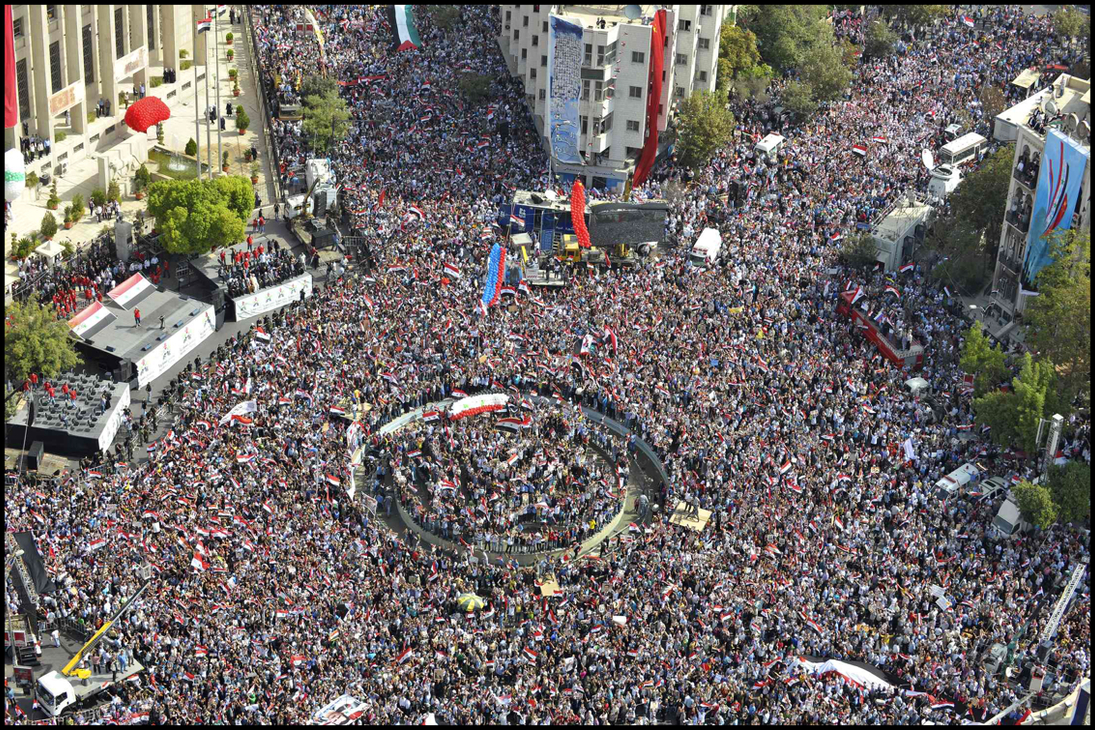
The picture above shows that more than one million Syrians rallied in Damascus in support of President Bashar al-Assad and his reform program on October 12, 2011. Photo taken from a helicopter by the Syrian Arab News Agency.
Below some snippets from this article: A Short History of the War on Syria (2006-2014)
In late 2006 the United States started to finance an external opposition to Syria’s ruling Baath party. Those exiles were largely members of the Muslim Brotherhood which had been evicted from Syria after their bloody uprising against the Syrian state between 1976 and 1982 had failed. In 2007 a plan for regime change in Syria was agreed upon between the United States, Israel and Saudi Arabia. The aim was to destroy the “resistance” alliance of Hezbollah, Syria and Iran.
By 2011 three years of drought, caused by global warming and Turkey’s upstream dams and irrigation projects, had weakened the Syrian economy. Large parts of the poor rural population lost their means of living and moved into the cities. They provided the fertile ground needed to launch an uprising against the Syrian state.
The U.S. part in the plan was to provide the media and “global opinion” cover for the insurgency. To that purpose it used the tool from its “color revolution” tool box. “Citizen journalists” were recruited, trained and provided with the video and communication equipment needed for media propagandizing. Others were trained in organizing “peaceful civil demonstrations”. The Saudis took care of the darker part of the plan. They financed and armed rebel groups, often related to the exiled Muslim Brotherhood, which had the task to instigate a wider insurgency by taking on government forces as well as the peaceful demonstrators.
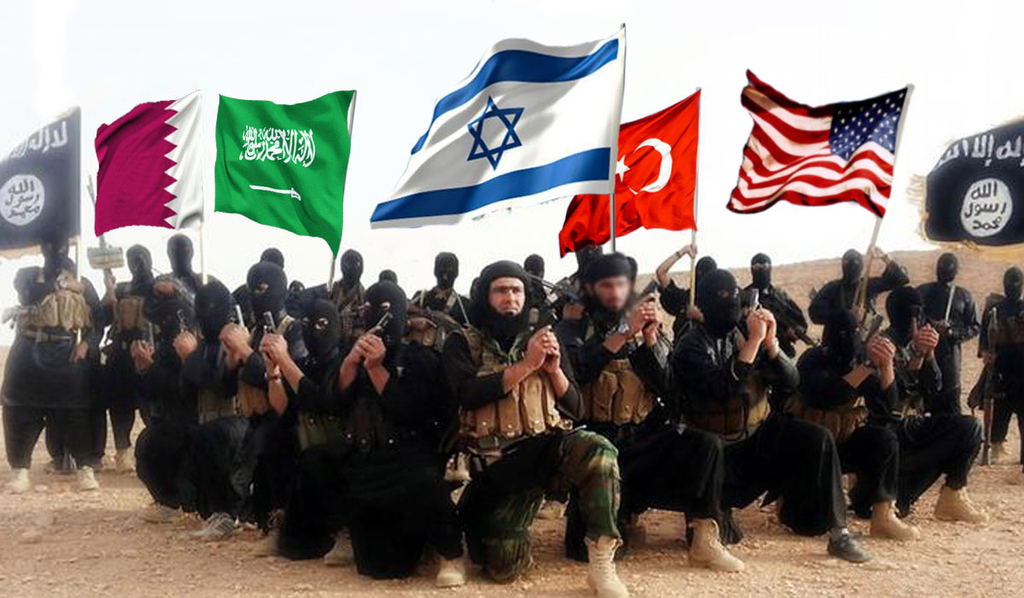
A local disturbance in Deraa near the Jordanian border was used to launch the uprising. Peaceful demonstration were held but soon shots were fired towards the police as well as towards the demonstrators. Inevitably both sides escalated. Groups armed by the Saudis target the government forces. Having colleagues killed and wounded the government forces retaliated against the demonstrators. Some of those took up arms themselves and fought the government. “Citizen journalist” propagandized the victims on the “peaceful demonstrators” side but never mentioned those on the government side. “Western” media agencies followed that scheme.
It was soon visible that the planned for “color revolution” strategy did not work. The Syrian state was more resilient than had been perceived. The Syrian president Bashar al-Assad was more beloved and respected than the insurgency instigators ever expected. He also fulfilled many of the demands the serious protesters had. The constitution was rewritten, new parties were allowed, elections held and the most abusive security forces came under stricter control. The big cities, even though predominantly Sunni, did not support or join the increasing violent and sectarian fighters. Defections from the Syrian army and from political cadres were few and unimportant. For some time the Syrian economy held up quite well. The general population as well as the government rejected the scheme of a sectarian divide.
The enemies of Syria had to increase their commitment. Saudi Arabia and Qatar used all their capabilities to recruit foreign Jihadis willing to fight in Syria. The CIA, using Saudi money, brought in weapons and thousands of tons of ammunition from all over the world. Insurgency groups were provided with training and battlefield intelligence. A group of exiles was build up as external future government.
[…]
June 4, 2014: Bashar al-Assad wins a landslide victory in the Syrian presidential poll with 88.7 percent of the vote. This will secure him a third seven-year term in office amidst a bloody civil war. Voters turned out at an amazing 73.4% and there were two other candidates running against him. The other two candidates for the top post were Hassan Abdullah Nouri, from the National Initiative for Administration and Change in Syria, and Maher Abd Al-Hafiz Hajjar, formerly from the People’s Will Party. No violations have been reported, Syria’s Higher Judicial Committee for Elections said.
According to an internal NATO study, 70% of Syrians support President Bashar al-Assad, 20% adopt a neutral position and 10% support the so-called “moderate rebels.” Also watch this documentary:
 Against the Grain