
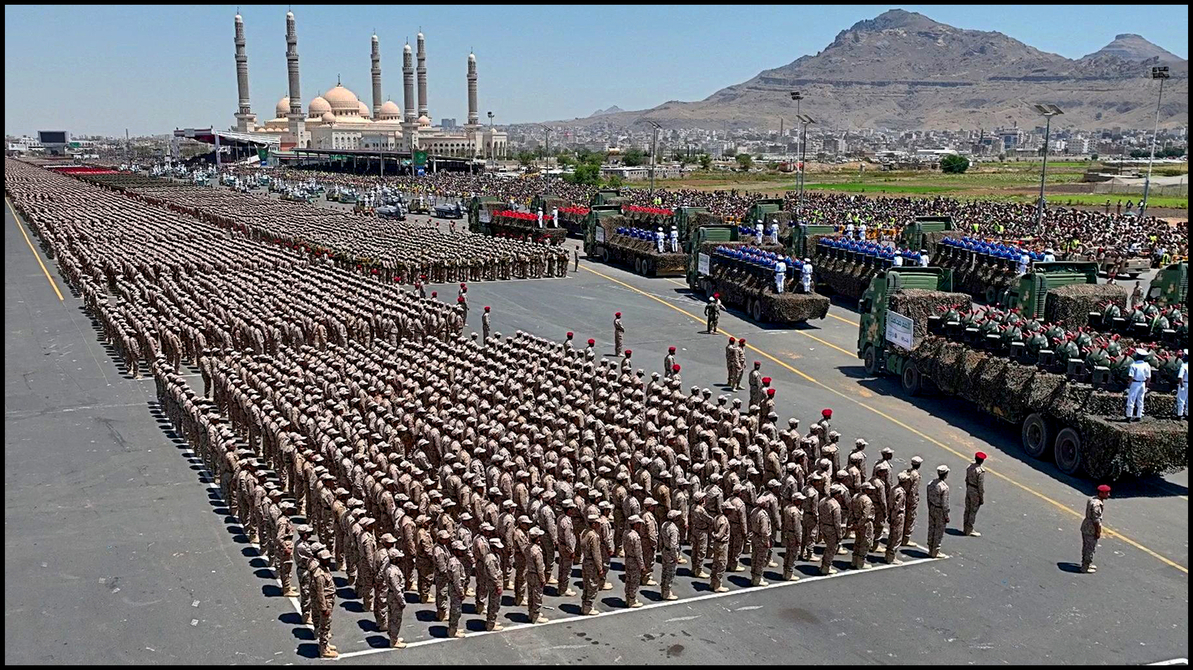
Photo (Reuters) showing a Houthi military parade, cropped and resized by me.
Tehran has spent decades building its Axis of Resistance, exploiting internal Mideast conflicts and U.S. wars in Iraq and Afghanistan. This network includes Hamas, Hezbollah, and Shiite militias in Iraq and Syria. But the Houthis are unique in that they’ve largely focused on fighting the U.S.’s Sunni Arab allies — Saudi Arabia, Bahrain and the UAE — and have so far been removed from the Arab-Israeli conflict.
The Houthis now have perhaps the most sophisticated arsenal of ballistic missiles and drones among Iran’s regional allies and proxies, known as the Axis of Resistance, according to Middle East analysts. But the militia’s geographical position makes it a particular threat to global commerce and energy shipments. Yemen sits astride the Bab-el-Mandeb Strait that serves as a choke point for ships entering the Red Sea and the Suez Canal. The Houthis also are in range of the Persian Gulf through which as much as 30% of the world’s oil passes.
The Houthis have displayed in recent years a willingness to strike major commercial targets, particularly in its war against Saudi Arabia and the United Arab Emirates. These operations include the 2019 drone attack on Saudi Aramco’s Abqaiq oil refinery in eastern Saudi Arabia; a January 2021 strike on the UAE’s Abu Dhabi commercial center; and attacks on commercial ships transiting through the Red Sea and Gulf of Aden.
Source: Semafor.com.
The resistance axis is a collection of groups loosely connected to Iran. The Iranian Revolutionary Guard Corp has trained these groups. But it did much more than the usual U.S. military training would do. The IRGC encouraged the groups to contact each other and to exchange knowledge. They now cooperate on all levels. Iran brought in new technologies and weapons and taught each group on how to make their own copies. Today Hizbullah intelligence people teach Houthi how to systematically interpret U.S. actions. Houthi and Iraqis exchange missile and drone building plans.
The axis of resistance has become an assembly of quite autonomous entities who no longer depend on deliveries or orders from Iran. But they all follow the same anti-colonial ideology.
The U.S. tried to interrupt the resistance development by, in 2020, killing Qasem Soleimani, the commander of the IRGC and founder of the resistance axis. It was in vain. The resistance was already too developed. It continued to grew on its own despite U.S. attempts of interference. After Soleimani’s death Iranian support for its resistance partners increased.
Source: Moon of Alabama.
 Against the Grain